

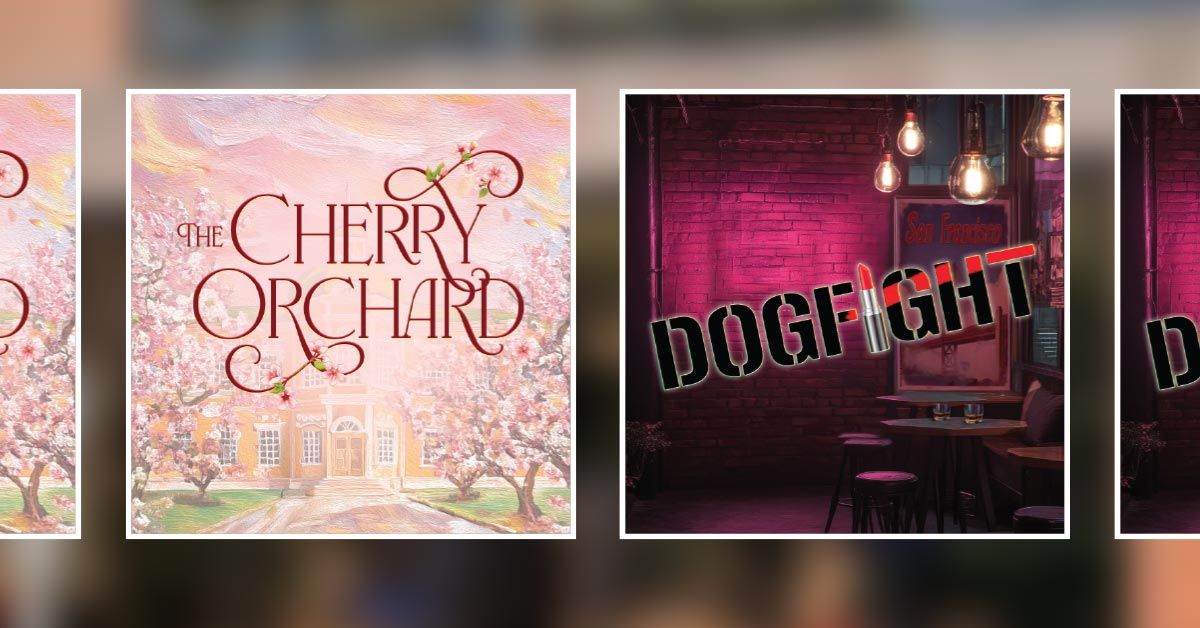
Since its publication in 1904, it’s been an open question as to whether The Cherry Orchard—onstage at Kalamazoo Civic this month—is a comedy or a tragedy.
Anton Chekhov, its author, saw it as the former; Konstantin Stanislavski, its first director, saw it as a tragedy. Like life, it intermingles elements of both.
This play, onstage for Kalamazoo Civic Theatre’s season January 16-25, tells the story of Madame Ranevskaya, an aristocratic Russian woman who returns to her family estate just as it’s about to be sold off to pay familial debts. The estate is beloved, not least because of the glorious cherry orchard living on it, and several offers are made to save it. Madame Ranevskaya is unmoved.
The madame has a seventeen-year-old daughter, Anya, who attracts the eye of Peter Trofimov, a young student and former tutor of Madame Ranevskaya’s son. Even as life seems to be ending for the estate, life itself goes on; the play offers a pageant of characters, from the up-and-coming to down-on-their-luck beggars. It’s a reminder that even in societies stratified by class (as if there were any other kind!), we don’t exist in bubbles.
There are earnest discussions of love, idealism, and beauty, all the more resonant because the play never loses sight of the baser comedy of life. The play’s both high-minded and clear-eyed: a rarity, and a welcome one.
“The themes of The Cherry Orchard are timeless,” wrote Dr. Miriam Thomas, this production’s director, “and Chekhov writes with a remarkable understanding of human nature—our desires and disappointments, our hopes and frustrations, the absurdities and dramas of everyday life.”
The play transmits great insights not only into aristocratic Ranevskaya’s own life, with its laughter and deep sadness, but into the lives of those around her. While she’s central, other characters, drifting into view as they orbit her, are themselves given great depth. The play’s understanding of the human heart has led it to be considered a 20th century classic.
That wasn’t always the accepted view. While audiences embraced it upon its release, critics were less quick to do so; despite that, it became hugely popular, achieving worldwide success. It’s been staged every year since its release.
Of course, the 20th century isn’t the 21st; the world has changed in enormous ways since pre-revolutionary Russia. Still, as much as border lines have changed—not to mention technology—the human heart is as it ever was. Of course The Cherry Orchard’s relevant. It’s about us.
Next up in the season, it’s hard to imagine a less gallant premise than that of Dogfight, the off-Broadway musical based on the 1991 film of the same name—hitting the Kalamazoo Civic’s stage Feb. 20-March 1. In 1963, three Marines, due to leave the next day for Vietnam, decide to have a dogfight: a contest to see which of them can bring the ugliest date to a dance. They each throw $50 into the pot; whoever wins gets it.
Asked about the challenge of casting unattractive characters, Kennedy points out the magic makeup and costuming can work. While he acknowledges that the premise might turn away some viewers, he’s confident that those who come will find themselves more than glad they did so.
Eddie Birdlace, one of the Marines, meets Rose Fenny, a waitress, at a diner. She’s more shy than unattractive, but he figures she’s his best bet, so he invites her to the dance. From these uncomfortable beginnings, Dogfight turns out to be surprisingly warm and true, and even, at times, sentimental.
It’s as much a musical about the 1960s as it is about an interpersonal drama. “It’s split right down the middle,” said Anthony J. Hamilton, artistic director of The Civic and director of Dogfight. The 1960s are commonly seen as a time of innocence lost, a view Hamilton agrees with. It’s no coincidence that the night of the dogfight is the night before President Kennedy was shot.
It’s told retrospectively, after that national loss of innocence. Birdlace, having survived the war, has returned to an America that seems very different than the one he left. He reminisces about the night of the dogfight, and about the young woman he met that night—how he found himself liking her more than he’d thought he would, and how he hurt her anyway.
The music for Dogfight is both period-appropriate, helping to set the scene, and emotionally resonant. “Dogfight” and “Pretty Funny,” in particular, have been embraced by musical theater fans. Words and music are by Benj Pasek and Justin Paul, who would go on to write the music for Dear Evan Hansen, a 21st-century Broadway touchstone.
The Cherry Orchard and Dogfight: one written over a century before the other. Despite their differences—one a musical, one not; one about events in living memory, one about a vanished past—they resemble each other more than might seem obvious. After all, they’re both about changing societies and the unchanging human soul
Kalamazoo Civic Theatre
329 S. Park St., Kalamazoo
kazoocivic.com
