
If you don’t know where to start: Note the details.
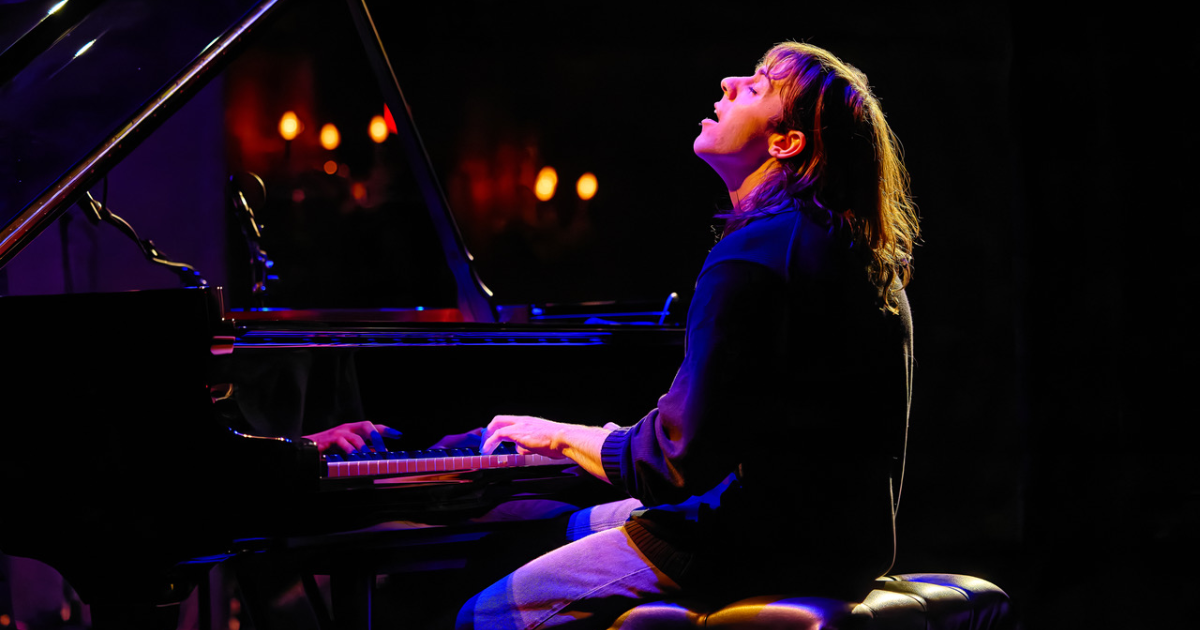
The way Esteban Castro throws their head back when a groove locks in. The little smiles exchanged between Lisa Kaplan and Matthew Duvall during a duet. The many flourishes of Kandace Springs as she seamlessly transitions from classical to jazz and back again.
If you’re not seasoned in the kinds of music presented at the Gilmore Piano Festival—by some of the greatest pianists in the world—going to your first performance might feel a little intimidating. How much am I supposed to know going in? Should I dress up? How do I truly appreciate this experience?
But the truth is, there are no rules. I mean, you should silence your phone, but other than that, all you need to do is arrive ready to embrace and explore whatever the musicians offer.
Personally, my starting point for losing myself in the music is paying close attention to the performers themselves and the details of how they interact with each other, their instruments, and the audience. If I don’t find something to focus on in the room, outside thoughts can start to push their way in. But more than that, it connects what I’m hearing to the humans onstage, which is the whole point of experiencing performance in-person.
Of course, it’s not hard to be present when the music sweeps you off your feet entirely, which is likely to happen over and over when you’re listening to musicians of the caliber that Gilmore Piano Festival brings to Kalamazoo. On May 5, I spent a whole day in town attending shows, seeing and hearing so many possibilities of what the piano can do.
First, Esteban Castro’s Trio brought a modern, innovative approach to jazz at the beautiful and historic Kalamazoo Civic Theatre. The double bass and drums were often shockingly gentle but by no means simple, laying down complex rhythms that paved the way for Castro to intricately explore on piano.
Some jazz is more improvised than others, and despite the fact I could see sheet music in front of them, this trio’s approach felt like they were constantly discovering, together, what the song would be as they played. It was exhilarating to go on that journey with Castro, the bass and treble voices weaving in and out of each other, occasionally coming together in rapturous harmony.
While I lack the terminology to tell you exactly how Castro’s approach is different from the jazz I’m used to, what I can say is that their sound has a bright, magical, almost fantastical quality, lending to that feeling of performance as adventure. The joy of it all was evident not just on drummer Jacob Patrone’s smiling face and the way he often looked delighted by what Castro was doing on the keys, but the involuntary dancing of the seated audience, and the “bravos!” that followed.
It was an entirely different experience than Kandace Springs’ trio in the evening. While the same three instruments were on stage, this was a lively, interactive show filled with singing, jokes and far more impressions than I expected (to be fair, I expected none).
Springs is a true bandleader, talking to the audience, asking us to sing along, hyping up her bandmates or challenging them to play certain songs on the spot, and just generally giving the people what they want. The set flew by as she interspersed her own take on classical favorites with jazz staples from Billie Holiday and Roberta Flack (she introduced “Killing Me Softly With His Song” as her karaoke song). We were moving, laughing, and occasionally singing along throughout.
It was interesting to see how much the approach differed from Castro, who barely spoke throughout the performance, certainly didn’t sing or do musical impressions, and played to an audience silent and enrapt. Yet both trios had the crowds on the edge of their seats, ending with standing ovations and enthusiastic cheers.
And then there was Eighth Blackbird, a contemporary sextet that explores the boundaries of what music can do. This was primarily evident with two famous pieces from Steve Reich: Piano Phase and Four Organs.
Piano Phase has two pianos playing the same part in unison, until one pianist begins playing slightly faster, and then the other slowly catches up, and this process repeats for roughly 15 minutes. It’s an incredible feat to pull off, as both pianists have to play nonstop while keeping their own time, falling in and out of sync with each other. By the end, Lisa Kaplan and Matthew Duvall were both smiling wide—at each other’s performances, and at the inherent humor of the musical cat and mouse.
Then, Four Organs is even more repetitive, with four musicians on electronic organs gathered around a table (“It looks like a seance,” said the man behind me) playing very slight augmentations on a single chord, slowly stretching it out from an eighth note to 200 beats over the course of 16 minutes. It’s all backed by one person on maracas, holding the tempo without pause in a marathon-like feat of endurance and rhythm.
The repetition of this piece infuriated some audiences in the 1970s, nearly causing riots. The worst I saw at the Gilmore show was a child who looked at his mom with a face that said, “How long will this go on?” Much of the crowd laughed when it was over, not at the performance itself, but as a recognition of the unique trip we all went on together.
But compositions like this are special things, experiences to lose yourself in. Reich compared it to flipping an hourglass and watching the sand run through, or standing on a beach as the waves roll in, feeling yourself slowly, methodically become buried.
And when Eighth Blackbird then returned to slightly more typical, yet still impressively innovative, pieces, they felt even more dynamic and engrossing. That included the world premiere of a piece called Spaces Between, designed intentionally so different ensembles can put their own spin on it. All six instruments were given their time to not just shine, but be used in fascinating and fun ways—one particular shriek of a flute even had the flautist laughing after. It was a delightful tapestry of beautiful moments strung together.
While I enjoy classical and jazz from time to time, I am by no means an expert, yet these three concerts—experienced in just one day without any major rush between destinations—gave me a day full of surprises and musical moments I’ll never forget. Not to mention delicious food and drink in Kalamazoo, at Studio Grill, Mocha House, Principle and Dabney & Co.
And I have to mention the April 30 performance with the Kalamazoo Symphony Orchestra that I went to, which featured a funny and moving mini-opera composed for the Gilmore festival, followed by an absolutely jaw-dropping performance of Tchaikovsky’s Piano Concerto No. 2, with 2024 Gilmore Artist Alexandre Kantorow on piano.
There’s truly nothing like the Gilmore Piano Festival, which brings the greatest musical talent in the world to West Michigan. Go for one performance, or go for 10. Either way, you’ll leave with your mind enriched, your heart full, and your horizons expanded.
2026 Gilmore Piano Festival
Kalamazoo
Apr. 30-May 10
https://www.thegilmore.org/