
In his heyday, Oscar Levant was a household name. A celebrated mid century composer, conductor, and concert pianist, he took turns on Broadway as a musician, and in Hollywood as an actor in feature films, including a role as Gene Kelly’s wingman in An American in Paris; and his quick wittedness made him a popular radio game show panelist and television talk show host.
And yet, many of us who didn’t know him then are unfamiliar with his genius, to which he referred with self deprecation. “There’s a fine line between genius and insanity,” he wrote in his memoir. “I’ve managed to cross that line.”
Oscar Levant’s brilliance, wit, and struggles with mental health and addiction come to life in the tightly-framed play Good Night, Oscar—currently in production at Farmers Alley Theatre in Kalamazoo in collaboration with the Gilmore Piano Festival—to tell a much bigger story about tortured artistry, suffering at the root of comedy, and the incredibly high price of fame.
Written by Doug Wright, whose I Am My Own Wife won the 2004 Pulitzer Prize for Drama, the show premiered in 2022 at the Goodman Theatre in Chicago, and after moving to Broadway won Sean Hayes the 2023 Tony Award for his depiction of Oscar Levant.
The story uses facts about Levant and the culture at the time through a fictionalized account of a 1958 Tonight Show episode. It’s sweeps week and the show has moved to the West Coast. Host Jack Parr is counting on Levant as a popular guest to boost ratings, but he’s nowhere to be seen two hours before the show. NBC Network Executive Bob Sarnoff is beside himself with worry, not just for Levant’s absence, but also for what might fly out of his mouth if he does appear. Parr, too, is panicked, especially when he discovers Levant’s wife, June, has had Levant institutionalized but has negotiated a four-hour leave, with an orderly to accompany him, so he can appear on television.
It’s high stakes for everyone, and everyone, it seems, is exploiting each other. “The promise of that applause is the only reason he hasn’t . . .” June trails off, forlornly.
But when Levant finally appears, the drama becomes much more complicated. Funnier. And tragic. Truly hilarious one-liners fly. Magic seems to happen as Levant amuses everyone around him while clearly suffering from his own demons. His OCD emerges in the way he stirs his coffee, his anxiety is apparent through his twitches, tics, and chain smoking, among other mannerisms, and he is haunted, quite literally, by auditory hallucinations of George Gershwin’s music—and his internalized emotional abuse.
“I gave up my whole life so I could be a footnote in his,” Levant says, and the way his complicated friendship with Gershwin continues to torture him after Gershwin’s death is a primary tension in the play that comes to a crescendo when Levant takes to the Steinway in the play’s emotional climactic scene.
Good Night, Oscar at Farmers Alley is a beautifully-paced roller coaster of emotion. With compelling characters, strong scenes, powerful performances, excellent technical work, and meticulous direction from Suzanne Regan, one hour and 45 minutes without intermission flies by.
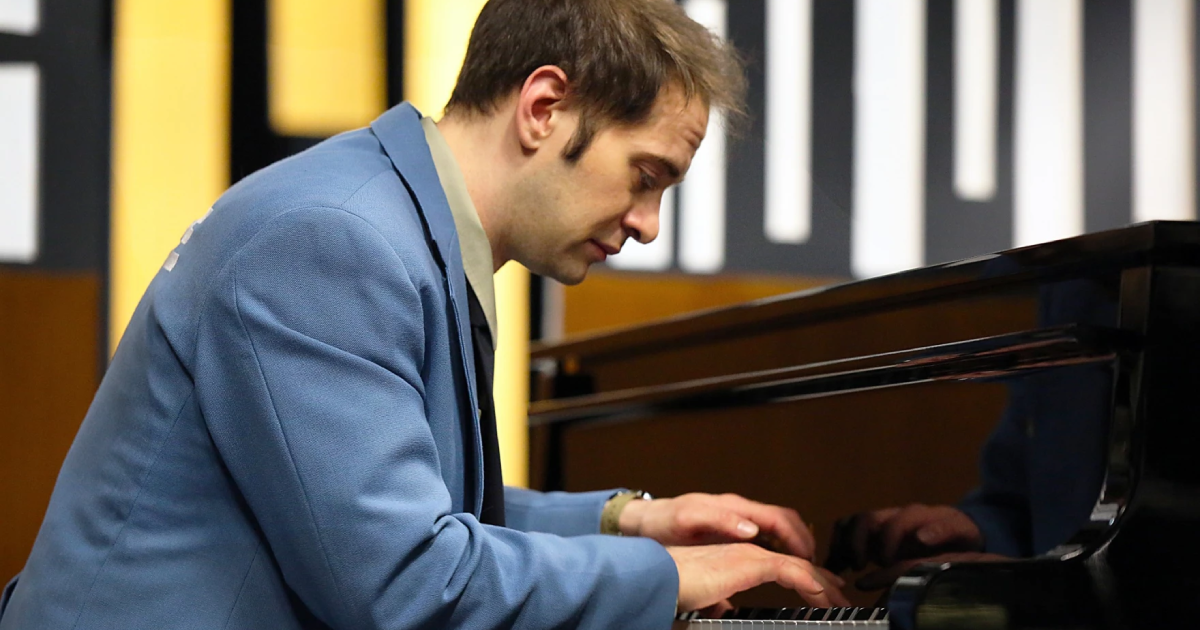
David Corlew is a phenomenal Levant, capturing the tortured artist’s physicality, his self loathing, and his wicked sharp humor to make him utterly believable, flawed and ever so lovable. He’s also a stunning pianist, a brilliant musician in his own right.
And every member of this ensemble rises to his level, from Drew Parker’s energetic Jack Parr to Atis Kleinbergs’ exasperated Bob Sarnoff (their scenes together are perfectly syncopated), to Veronica Dark’s emotive June, to Delanti Hall’s fiercely empathetic Alvin, to Jacob Tyler Reinstein’s guileless Max, to Jackson Medina’s commanding Gershwin. This cast works together beautifully.
Samantha Snow’s clever set is visually appealing and allows for a small space to quickly become several locations with seamless shifting of hanging panels and set pieces. Lori Green’s simple costumes capture the period and help build character—as do Steve Hodges’ wig design. Savannah Draper’s thoughtful props, from cigarettes and lighters to flowers to coffee and water pitchers and more, are surprisingly important to the action. And Lanford J. Potts’ lighting design is subtly effective until it changes the temperature in the room exactly when it needs it.
There’s so much chaos and complexity created and contained so elegantly in this carefully-crafted show, you almost don’t know what’s hit you by the end. But in witnessing this imagined event shot through with verisimilitude, there’s opportunity to come close to the artistry, the suffering, and the humor of one of the American greats who deserves to be known and remembered—as well as the big ideas his life and performances invite us into, about the bravery and humor of telling the truth as well as the love and despair that can lie beneath genius.
Good Night, Oscar
Farmers Alley Theatre
221 Farmers Alley, Kalamazoo
Apr. 16-May 2
farmersalleytheatre.com